Jimi Hendrix Experience Serigraph
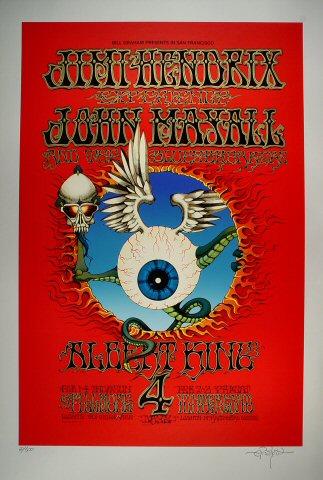
Image may not exactly match item shipped.
Jimi Hendrix and the Flying Eyeball are images indelibly linked in the psychedelic poster art of the late Rick Griffin. Griffin discovered The Eyeball, in a much more benign form, in the 1950s auto detailing art of California pinstriper Von Dutch and reworked it over time to become the winged, bloodshot figure parting a ring of fire with serpent-like tentacles. The highlighted lettering, vivid color, and complicated imagery reflect Griffin's attention to precise details and the influence of Indian lore and archeology on his work. The Eyeball became associated exclusively with Hendrix's music in future billings and recordings of his performances.
The 1st and only printing of this serigraph was a print run of 500 produced in 1989. They are all signed and numbered by Rick Griffin, measure 40 7/8" x 28 7/8", and may include an embossed "ART ROCK" logo at the bottom. The numbering says "xxx/500".
Prior to trimming Griffin picked out the best and the worst of these. The best he designated as Artist's Proofs, of which less than 50 exist. These are also signed and numbered, but the numbering shows "A/P xx". They measure 44" x 28 7/8", similar to the full run but with untrimmed sides.
The "worst" are designated as Press Proofs. They are still quite beautiful, with minute flaws most people would not recognize, but enough that Griffin chose not to sign them. An unknown number exist. These also measure 44" x 28 7/8", similar to the full run but with untrimmed sides.
Rick Griffin grew up in the surfing culture of Southern California, a milieu which had a profound influence on his art. After high school, he worked on the staff of Surfer magazine and created the best-known surfing cartoon character of the time, Murphy. After his move to San Francisco in 1967, be began combining eclectic typefaces and decorative borders with brilliant colors in his concert posters. Griffin's compositions were complex without being illegible. A perfectionist, Griffin often applied dozens of overlays and redrew lettering again and again until he was satisfied. In the early 1970s, Griffin became a born-again Christian and religious themes dominated his work until his death in a motorcycle accident in 1991.